EN

HACCP for the Truck: What Food-Safety Officers Should Spec Before the First Perishable Load
HACCP for the Truck: What Food-Safety Officers Should Spec Before the First Perishable Load
Perishable distribution lives and dies by a food-safety record that an auditor can open on the spot. Under HACCP and its regional equivalents, the carrier is expected to control temperature as a documented process: a defined range, a means to reach and hold it, and evidence that both happened on every run. The refrigeration unit is the control point in that process, and specifying it wrong is the cheapest-looking, most expensive mistake a food business can make.
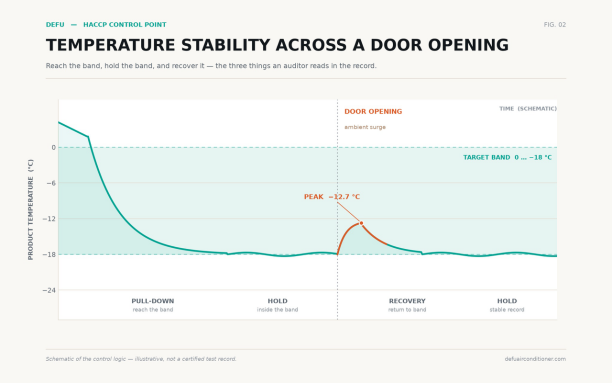
The record an auditor reads: reach the band, hold it, and recover it after the doors open. Schematic of the control logic.
The Control Point Is Temperature Stability
In a perishable HACCP plan, the hazard is the load warming above its safe range; the control point is the reefer unit’s ability to reach and hold the target through repeated door openings, dock heat and ambient load. A food-safety officer who specs on nominal capacity alone inherits the risk that the unit meets the number in the lab but not in the box. DEFU belt-driven units pair a 5.0 kW compressor with an 18.0 kW condenser specifically to buy stability under repeated heat surges, so the recorded profile stays inside the safe band where it needs to be.
What to Verify Before You Specify
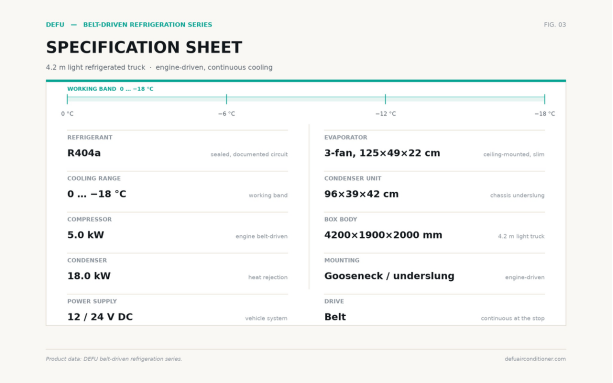
One sheet, four parts: the compressor, condenser, evaporator and refrigerant that make the critical limit holdable.
- Reach-and-hold evidence: confirm the unit’s documented pull-down to the working range and its recovery time after a representative door opening — not just its steady-state number.
- Uniform air distribution: the ceiling-mounted slim evaporator delivers a ducted cold-air curtain toward the rear, reducing hot pockets behind pallets where excursions hide.
- Refrigerant and serviceability: R404a in a sealed, documented circuit makes the control point auditable; specify the spare-parts list and service access at the same time as the unit.
The ceiling evaporator ducts cold air to the rear, so the hot pocket behind the pallets never forms.
From Spec to Record
The unit controls the temperature; the process controls the evidence. Standardize a pre-cool check before each load, log the pull-down, keep the temperature record complete across handovers, and treat the evaporator as a cleanable, inspectable part of the food-safety system rather than a black box. When the record is flat and the process is written down, the audit becomes a demonstration of routine instead of a scramble.
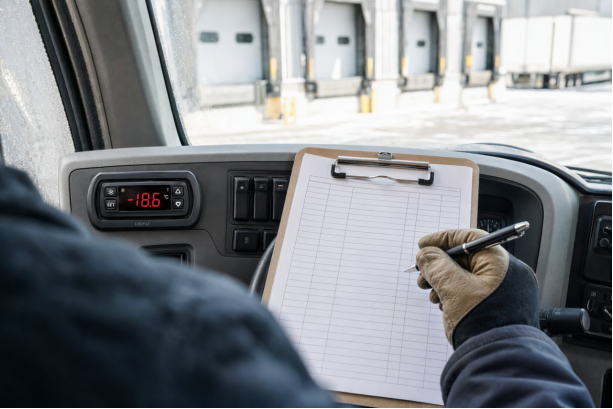
The unit controls temperature; the paperwork controls the evidence. Setpoint and actual reading logged at departure.
Writing the Temperature into the HACCP Plan
A control point only counts if it is written into the plan with a critical limit and a monitoring method. For the truck, the critical limit is the target band, the monitoring method is the temperature record taken at each stage, and the corrective action is what happens when the record drifts. The refrigeration unit is the piece that makes the limit holdable. When the operator can point to a unit that is documented to pull down to the band and to recover quickly after a door opening, the HACCP plan moves from an aspiration to a control that is actually enforced on every run, rather than a policy that is only true on paper.
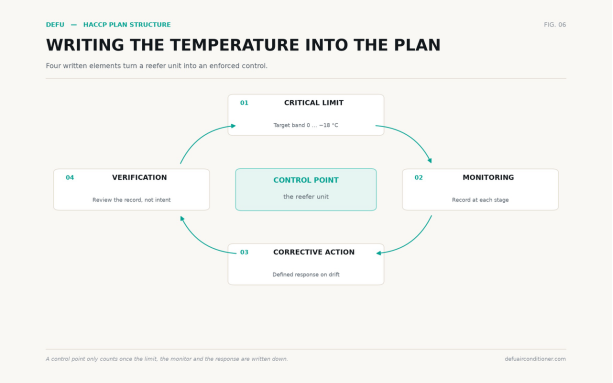
A control point only counts once the limit, the monitor and the corrective action are written into the plan.
A Pre-Load Checklist That Keeps the Record Defensible
- Confirm the pull-down before loading: the box should already be at or below the critical limit before the first pallet goes in; loading into a warm box is the single most common cause of an early excursion.
- Log the setpoint and the reading: record both the target and the actual at departure, so the audit sees intent and evidence together.
- Keep the evaporator clean: a dirty coil is a slow, invisible capacity loss that shows up later as a drifting record; schedule the clean as part of the food-safety routine, not as an afterthought.
Three checks before the first pallet: pre-cool the box, log the setpoint, clean the coil.
Frequently Asked Questions
- Which mount is easier to keep audit-ready? The gooseneck and underslung belt-driven units are both engine-driven and deliver a stable profile; choose the mount by body layout and service access, then standardize the record-keeping across both so the audit sees one method.
- Does the refrigerant matter for food safety? R404a is an established, well-documented refrigerant for commercial refrigeration, which supports a clean, defensible specification in the plan.
- Is a belt-driven unit the right choice for frequent short drops? Yes. Because the compressor runs off the engine through a belt, cooling is continuous at the stop as well as on the move, which is exactly where a perishable route with many short drops is hardest on the record.
Belt-driven series in gooseneck and underslung mounts: continuous cooling at the stop, not only on the move.
For food-safety teams, DEFU's gooseneck and underslung belt-driven refrigeration series are the control points that hold perishable loads inside their safe range. Browse the refrigeration range at https://www.defuairconditioner.com and send us your target temperature band, stop pattern and audit requirements; we will return a unit specification with the matching pull-down and documentation.